We develop three emerging digital health technologies, working with patients in cancer, cystic fibrosis, and memory and brain health.
01 · VRx
Virtual reality therapeutic medicine
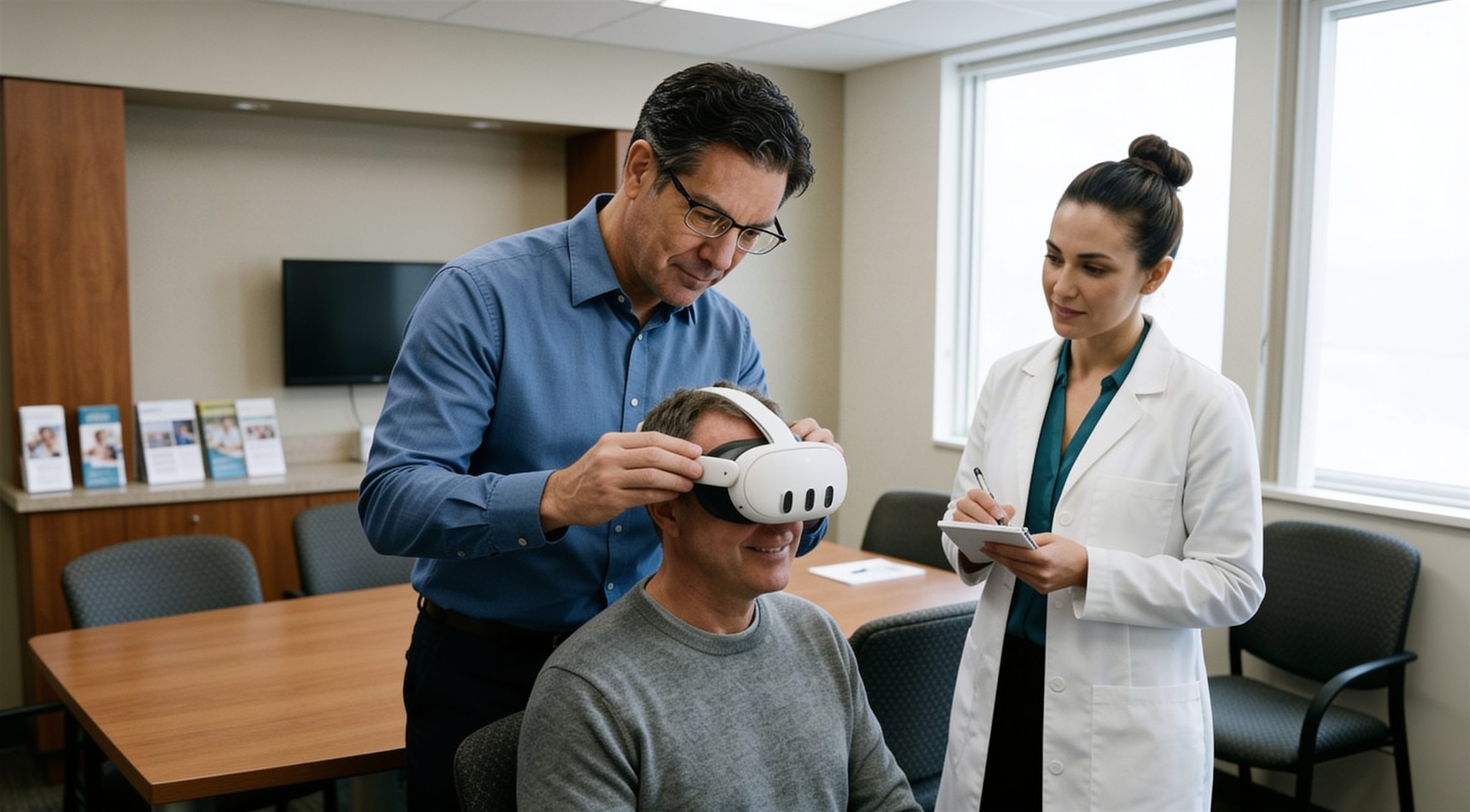
Our Virtual Reality Cognitive Rehabilitation Training platform (VR-CRT) treats mild cognitive impairment in patients with cancer, dementia and stroke. Patients focus and filter visual and auditory information as they move through a 3D, game-centered environment, with the aim of improving synaptic plasticity through movement and selective-attention exercises.
An initial pilot study showed improved verbal fluency, executive function and broader cognitive plasticity. Next, ai-VR-CRT adds AI for real-time player modulation and personalized difficulty.
Studies
Current
VR-CRT 1.0 with Alzheimer’s/related dementia and neuro-oncology patients with MCI, at the UC Cancer Center and UC Gardner Neuroscience Institute.
Current
VR cognitive gaming for critically ill older adults with delirium in the pulmonary ICU, with Indiana University School of Medicine and the Institute of Aging.
Forthcoming
VR cognitive and motor therapy for post-stroke patients, with Sapienza University and the Santa Lucia Foundation, Rome.
Forthcoming
An AI-powered in-home VR cognitive therapy for early Alzheimer’s patients with MCI, with the UC Gardner Neuroscience Institute and the Colleges of Medicine and Nursing.
02 · VOC biosensors
Diagnosing disease by scent.
We pair volatile organic compound (VOC) biomarkers with nano-sensors and handheld smart sensor systems for accurate, noninvasive detection. The question we ask: is VOC detection, coupled with biometric readouts, robust and sensitive enough to diagnose disease?
Prostate cancer
Canine-inspired identification of VOC biomarkers in urine, using portable GC-MS and a handheld nanosensor system for screening in clinics and at home. American Cancer Society.
Cystic fibrosis
A handheld smart sensor, integrated with machine learning, to detect pulmonary exacerbations at point of care from breath. NIH / NHLBI.
Type 1 diabetes (prior work)
A canine-inspired smart sensor for detecting hypoglycemia from human breath. National Science Foundation, 2015–2019.
03 · mHealth
Connected care, designed around people.
We develop, test and implement mobile apps, web portals, dashboards and backend databases that deliver community-focused, patient- and caregiver-centered cancer care, with a focus on underserved patients and their families.
FamCare+
An mHealth platform that connects families at home with clinicians at the bedside, to reduce anxiety and depression among families of cancer patients in rural Kentucky.
Comprehensive Connected Cancer Care (C4)
Advancing health equity by improving timely access to community-focused services and education for rural, low-income and uninsured communities. Merck Foundation.
Children Eating Well (CHEW)
A smartphone application for WIC families, with Vanderbilt. USDA, 2017–2024, completed.
Active funding
| Project | Funder | Years | Role |
|---|---|---|---|
| VR game-based cognitive training for breast cancer survivors at risk for MCI | American Cancer Society | 2025–2027 | PI |
| Hand-held smart sensor for detecting cystic fibrosis pulmonary exacerbations | NIH R01 | 2024–2028 | Co-PI (Site PI) |
| VOC biomarkers of prostate cancer using portable GC-MS and a hand-held nanosensor | American Cancer Society | 2024–2028 | Co-PI |
| Comprehensive Connected Cancer Care (C4) Center | Merck Foundation | 2022–2027 | Co-I |
Full funding history is listed in the lab director’s UC profile and CV.